
My hospitality experience in Poland.
It took me quite some time and a lot of thought to finally sit down and start writing this article. Putting myself out there or showcasing my ideas/opinions isn’t necessarily something I enjoy. However, a friend of mine from Singapore once told me, “It doesn’t matter what you like in this business; what matters is where you want to go, and therefore, certain things are necessary to get you there.” Those who know me well are aware that I travel primarily to learn and discover new things about coffee, the hospitality industry, and the general culture of the places I visit. Over the last few years, my involvement with coffee and coffee shops has led me to look beyond just the culture and the final product, and focus on the systems of each company, their automations, layouts, and the know-how of the people working there. Naturally, during every visit, I will seek out the best spots from which I might take away or learn something, and I never skip asking the staff about the practices they use. It is amazing how open people are to sharing details about how they craft a product, when they could very easily just say “it’s a trade secret” and end the conversation right there.
Let me give you a little background and some data on Poland’s coffee scene.
Before I go further into what I saw on the ground, I think it’s worth sharing a bit of the bigger picture, because it puts my four days in Kraków into perspective.My girlfriend recently finished her studies, so we decided to go on a trip to celebrate, as we’ve had a genuinely challenging year. That’s how we ended up in Krakow, a large city in the south of Poland with a rich history and plenty of things to see and do.
Note, I would highly recommend that everyone visits Auschwitz and Birkenau to see and learn about the darkest part of modern history. But let me not get sidetracked, I want to talk to you about my experience with Poland’s hospitality scene.
The first thing that surprised me, once I started digging into the numbers, was that Poland is, on paper, a nation of instant coffee drinkers. Over 80% of adults drink coffee daily, yet the actual volume consumed per person is remarkably low, somewhere between 0.7 and 2.5 kg a year, well under the European average of 5 kg. So this isn’t a country with a long-standing culture of sitting over a slow filter coffee; it’s a country that drinks coffee constantly. Knowing this made what I actually experienced in Kraków feel even more striking, because none of what I saw felt like a “quick instant coffee” culture at all.
That’s because what I was witnessing is, in industry terms, still genuinely new. The first specialty coffee shops in Poland only opened in 2010 and the country now counts 183 specialty coffee shops and roasters nationally. So unlike the UK or Greece, where specialty coffee has had more time to mature, argue with itself, and settle into an identity, what’s happening in Poland right now is a scene that’s still actively being built.
Part of why this happened so fast, I think, comes down to timing. The pandemic pushed people to drink more coffee at home and to care more about doing it properly… home consumption jumped from 57% to 63% between 2019 and 2020, bean sales rose over 20% the following year, and Poland is now, unexpectedly, the third-largest coffee machine market in Europe.
All that said, specialty coffee still makes up less than 2% of Poland’s entire coffee market. So what I experienced in Kraków wasn’t representative of the country as a whole… it was a concentrated, deliberate pocket of people doing something quite different from the mainstream.
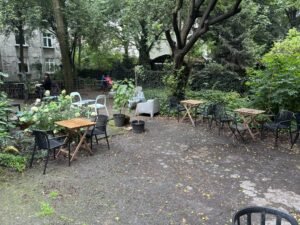
I lived in Greece for many years, a time during which I didn’t pay much attention to the hospitality sector or coffee, and then in the UK, which is essentially where my journey began. In Poland, unlike other places I’ve visited, the hospitality sector differs—for instance, from both Greece and Italy. The concept of the “coffee shop” pure and simple is alive and kicking, unlike what happens in Greece where we have more of an “all-day bar” concept. In practice, this means that coffee shops focus more on what they actually know how to do well, and they don’t serve everything, all day long. As a consumer, someone who does a few things and does them well inspires more confidence in me than the opposite. Specialization is something I believe improves both the product and the consumer experience, as what you ultimately receive has more value. Furthermore, the interaction with the staff is better, as is the overall impression of the visit, because everyone has been tuned to work with customers who are there for specific products. It’s worth mentioning here that the psychology of a consumer going out for a drink is entirely different from that of a person going out for a coffee and a chat.
- So, the first thing I can say about Poland that I really liked is that the hospitality venues had an identity. Their design had character, and the tableware they used with the end consumer in mind showed great taste. Unlike what happens in the UK, where I often see more emphasis being placed on the equipment—like the machine and grinders used to make the coffee—rather than the serving experience itself. So, observation number 1: the shops had specialization.
- Specialty coffee shops mostly offered espresso and filter coffee, but they also had “specials of the season” meaning signature coffee drinks. I frequently noticed that the coffees featured some kind of foam, which definitely offers something different to the consumer experience.
- The brunch-style food was clearly of higher quality, with larger portions and more options. Compared to what I’ve seen and gotten used to in the UK and in Chester, the food was vastly superior; brunch spots put a particular emphasis on eggs, like Benedict or Royale, and there were also many more bakeries by comparison for sit in or grab and go experience. I should note here that at the good brunch spots, the prices were close(r) to the ones in Chester food wise.
To sum up, I came away thoroughly pleased with the whole trip, the people we met, the sights we saw, the history we partly remembered with compassion, and I would certainly like to visit Kraków again, and perhaps at some point the city with Poland’s largest port, Gdańsk.
Dziękuję,
Theo Ioannidis
Coffee professional & MSc Nutritionist
Reference List:
Czarniecka-Skubina, E., Pielak, M., Sałek, P., Korzeniowska-Ginter, R. and Owczarek, T. (2021) ‘Consumer choices and habits related to coffee consumption by Poles’, International Journal of Environmental Research and Public Health, 18(8), 3948. Available at: https://pmc.ncbi.nlm.nih.gov/articles/PMC8069606/.
CBI (Centre for the Promotion of Imports from Developing Countries) (2022) What is the market potential for coffee from Poland? Available at: https://www.cbi.eu/market-information/coffee/poland-0/market-potential.